The Great Reset: Five Tech Shifts Every Professional Must Prepare For
Five disruptive shifts are redefining professions, organizations, and industries. From autonomous systems to natural programming, here’s how the Great Reset is reshaping our future.
Dr. Rajendra Pratap Gupta
August 30, 20254 min read
Five Disruptive Shifts That Will Redefine Professions and Organizations
We are entering an era where technology is no longer just an enabler—it is a disruptor of systems, professions, and even our identities at work. The tectonic shifts happening now will redefine what it means to be a professional, an organization, or even an industry. Here are five systemic shifts you cannot ignore:
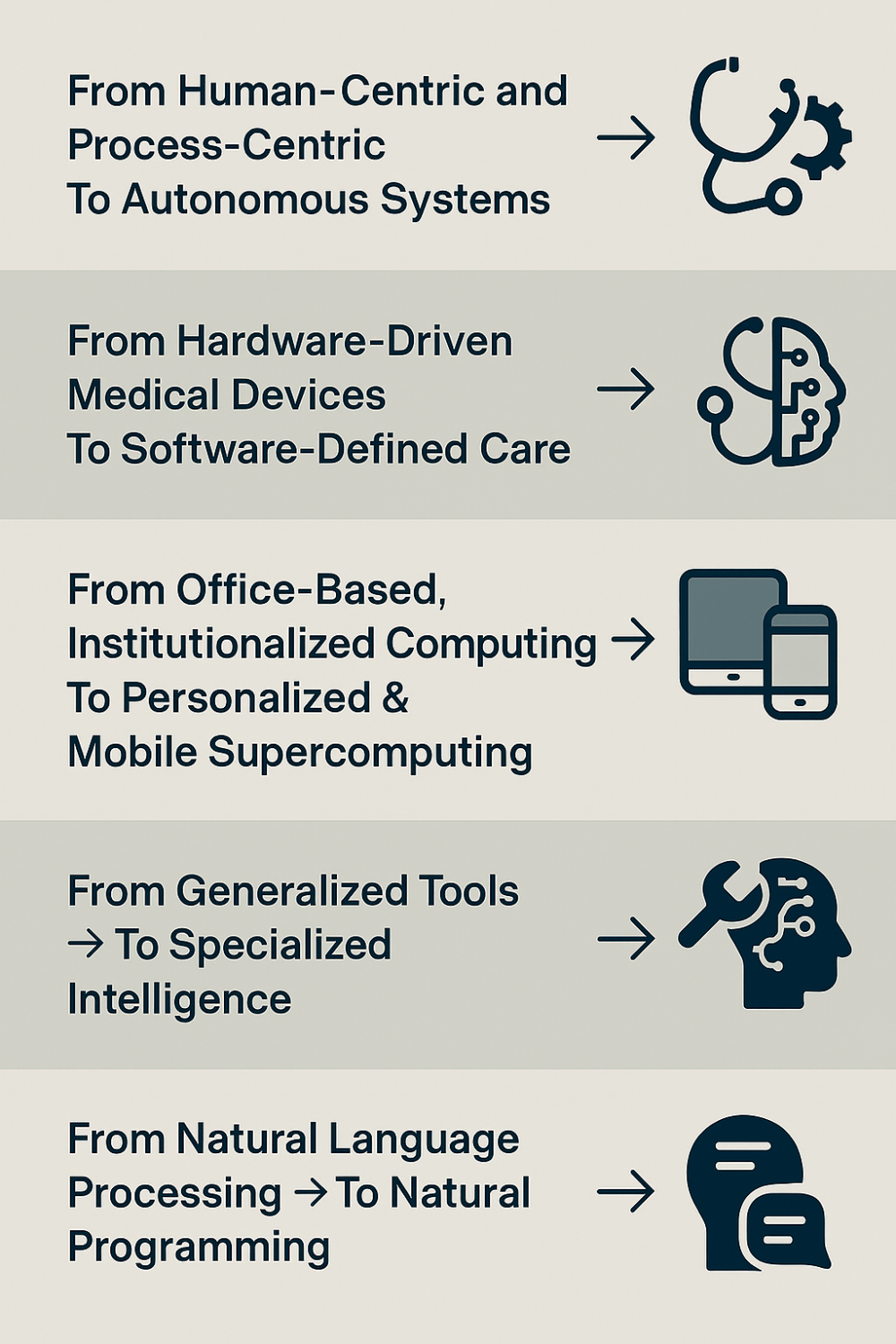
1. From Human-Centric and Process-Centric → To Autonomous Systems
For decades, systems were built around humans and rigid processes—manual entries, approvals, and paper trails. Today, the shift is toward self-governing systems.
- Hospitals: AI algorithms triage patients before a doctor arrives.
- Banking: Micro-loans get approved in seconds by AI.
- Supply Chains: Warehouses run on robots that restock, pick, and deliver without human involvement.
The role of humans is shifting from operators to custodians of ethics and oversight.
Yesterday, humans ran the system. Today, the system runs itself.
2. From Hardware-Driven Medical Devices → To Software-Defined Care
Medical devices were once bulky machines—ventilators, infusion pumps, monitors. Now, the real disruption is software as a medical device (SaMD).
- A smartwatch app can detect atrial fibrillation.
- Digital therapeutics treat ADHD or insomnia without a pill.
- AI scans outperform radiologists in detecting cancers.
Hospitals are no longer just filled with machines; they are turning into app stores for health. Doctors must now prescribe not only drugs but also algorithms.As I say, hospitals have gone beyond the beds - from bedside to website.
The stethoscope was once a symbol of medicine; tomorrow, it may be the algorithm.
3. From Office-Based, Institutionalized Computing → To Personalized & Mobile Supercomputing
In the past, computing was centralized and institutionalized-mainframes in corporations, desktops in offices, and servers in climate-controlled rooms.Access was limited, costly, and tightly controlled. Today, computing has become personalized and mobile.
Your smartphone is now more powerful than the Apollo 11 mission computer, and it fits in your pocket.
- A rural health worker in India can use a phone for diagnostics, e-payments, and medical records.
- A student can access entire libraries of knowledge on a handheld device.
- Entrepreneurs can run global businesses on cloud apps directly from their phones.
This shift has dissolved the walls of the office and placed immense power in the hands of individuals.
Computing has moved from the boardroom to the bedroom, from the office desk to your palm.
4. From Generalized Tools → To Specialized Intelligence
Early IT systems were “one-size-fits-all”: generic ERPs, broad CRMs. The new wave is hyper-specialized AI and platforms.
- In medicine, AI is trained specifically for radiology, pathology, or dermatology.
- In finance, algorithms serve micro-lending in rural villages differently from urban wealth management.
- In agriculture, drones and AI monitor crop health plant-by-plant.
Specialization is now the ultimate competitive edge.
The age of generalists is fading; in the digital era, specialization is survival.
Mastery of tech can make you a ‘multi-specialist’ — Dr. Rajendra Pratap Gupta
5. From Natural Language Processing → To Natural Programming
We once learned machine languages—C, Java, Python—to command computers. Now, machines are learning our language. Natural language is becoming the new programming interface.
- Doctors can ask: _“Show me all my diabetic patients with high risk scores”—and the system will generate the dashboard.
- A lawyer can request a draft contract in plain English—and AI will build the legal framework.
- Entrepreneurs can prototype apps by describing them in words, not code.
This shift democratizes innovation, putting creation power in the hands of every professional.
You no longer need to learn the machine’s language—because the machine has finally learned yours.
The Takeaway
These five shifts in what I call the ‘GREAT RESET’ are not futuristic—they are here, now. They signal a world where:
- Systems run themselves
- Devices are defined by code
- Computing is always in your pocket
- Specialization beats generalization
- Language becomes code
The real disruption is not in the technology—it is in whether professionals and organizations can adapt fast enough. Digital tools are not optional anymore—they are existential. Reinvent, or risk irrelevance.
Let’s discuss this and more at www.globalsummit.health
Dr. Rajendra Pratap Gupta, PhD
Global Digital Health Summit, Expo & Innovation Awards • Health Parliament • Academy of Digital Health Sciences
#futureofwork #digitalhealth #artificialintelligence #innovation #greatreset #futureofmedicine #digitaltransformation #futureofsurgery #AI #techshift
Share this article
Pass it along to a colleague in healthcare or digital health.
Related articles
Keep exploring insights from GDHS.
Sep 06, 2025 · 5 min read
The World Leaders are Coming for YOU – Listen. Meet. Speak. Get Featured. Upskill.
Join the Global Digital Health Summit in Mumbai from September 19-21, 2025. Interactive panels with global healthcare leaders, potential national television exposure, and opportunities to upskill in the digital age.
Aug 01, 2025 · 2 min read
Become a Digital Health Ambassador
Let's RESET the Future of Health—Join GDHS 2025. From 19–21 September at Mumbai's Jio World Convention Centre, we invite you to press the RESET Button—to rethink, re-wire, and re-scale healthcare for becoming digital-first.
Oct 09, 2026 · 4 min read
Are We Prepared for the Mental Health Emergency of the Digital Age? How can Start-ups help?
Why every healthcare CEO, pharmaceutical leader, policymaker, investor and technology innovator must rethink mental health before the digital revolution rewrites the human mind.
Oct 04, 2026 · 7 min read
I Didn't See It Coming So Soon: The Sentence That Will End Many Healthcare Careers
Dr. Rajendra Pratap Gupta examines how rapidly advancing AI could reshape healthcare roles and why leaders need to move from discussion to implementation.