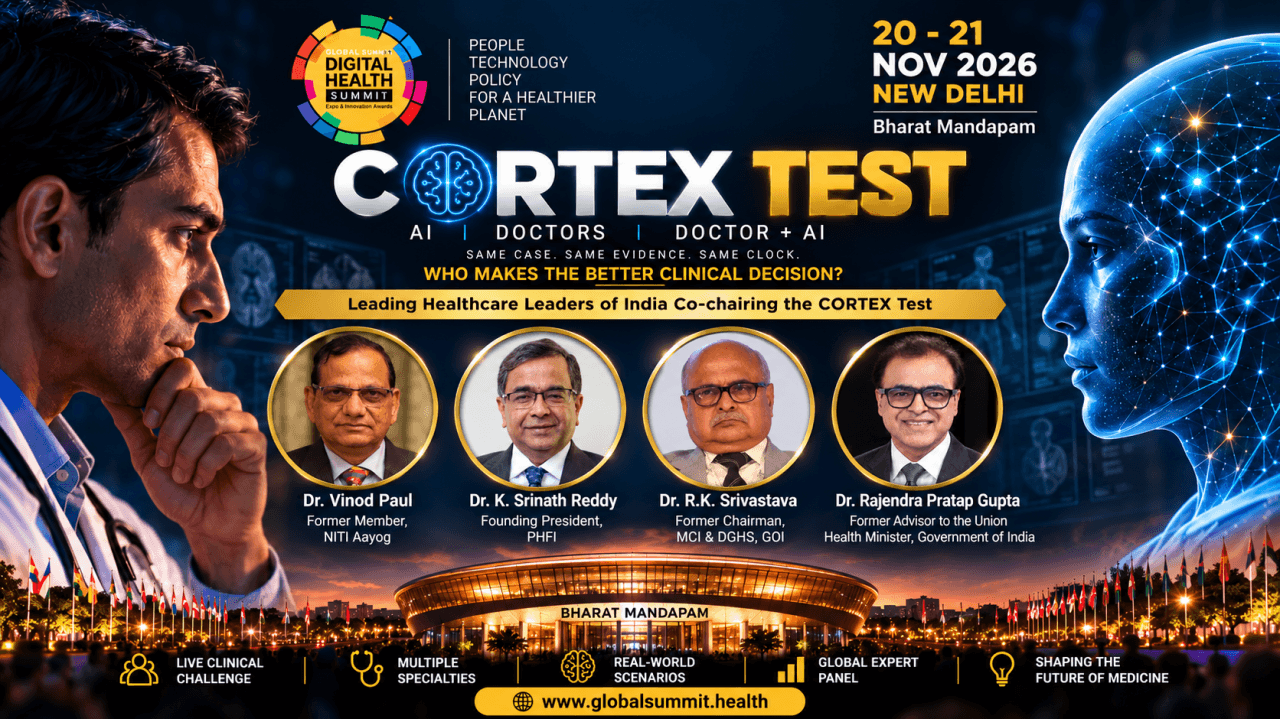
CORTEX TEST: The Day Medicine Puts AI on Trial
The CORTEX Test at GDHS 2026 compares AI, doctors and doctors using AI in a live clinical challenge across multiple specialties.
by Dr. Rajendra Pratap Gupta
October 01, 2026
3 min read
AI has learned medicine. Now we need to know whether it has learned how to practise medicine @ Dr. Rajendra Pratap Gupta, PhD
That is the question we intend to answer on 20–21 November 2026 at the Global Digital Health Summit, Bharat Mandapam, New Delhi.
The CORTEX TEST will put AI, doctors, and doctors using AI into a live clinical challenge across multiple specialties. Same case. Same evidence. Same time. Three approaches: AI alone, doctor alone, and doctor + AI. Then we ask the question that could redefine modern medicine: Who makes the better clinical decision?
“AI learned medicine. But did it learn how to practise medicine?”
This is the fundamental premise on which I designed the CORTEX Test.
This is not another AI benchmark. It is not about whether a machine can answer examination questions faster than a physician. Medicine is not an examination hall. Real clinical practice is messy, incomplete, uncertain and deeply human. A doctor must interpret ambiguity, recognise risk, understand context, communicate uncertainty and ultimately take responsibility for a decision. AI, on the other hand, brings extraordinary computational power, instant recall, pattern recognition and access to knowledge at a scale no human brain can match. Which is why the most important contest may not be doctor versus AI at all. It may be doctor + AI versus doctor without AI. But I promise, there is a much bigger surprise in store. Global leaders will be onsite and we will try to end the suspense around, whether AI learned medicine or AI learned to practice medicine.
“The future of medicine may belong neither to the doctor nor to the machine. It may belong to the doctor who knows how to think with the machine BUT , do not jump to conclusion. We will test the clinical competence of technology before the tallest leaders in medicine and healthcare on 21st November.
That has enormous implications. For hospital CEOs, it could redefine clinical workflows, training, quality standards, technology investments and even what constitutes clinical excellence. For pharma, it could reshape diagnosis, treatment selection, clinical trials, pharmacovigilance, real-world evidence and how the right therapy reaches the right patient.
For doctors, however, the question is much more immediate. We have spent years debating: Will AI replace doctors? We will get you closer to the answer before the GDHS2026 draws to a close.
The more urgent question is:
Will doctors using AI outperform doctors who do not?
If the answer is yes, the implications for medical education, licensing, hospitals, insurers, regulators and the profession itself will be profound.
The CORTEX TEST is therefore not just testing artificial intelligence. It is testing the future operating model of medicine, and perhaps the most important outcome will not be discovering whether AI is better than a doctor, or it will be discovering how much better a doctor can become with AI.
The CORTEX Test co-chairs are India’s undisputed tallest leaders, who have made phenomenal contributions to transforming healthcare in India, and beyond.
“The greatest breakthrough in medical AI may be just a few weeks away. See you on 20–21st November at www.globalsummit.health. Block your seat to witness the history in the making!
Dr. Rajendra Pratap Gupta, PhD
#CortexTest #FutureOfMedicine #HealthcareAI #ArtificialIntelligence #Doctors #HospitalLeadership #Pharma #ClinicalAI #DigitalHealth #GDHS2026 #superintelligence Health Parliament Global Digital Health Summit, Expo & Innovation Awards Academy of Digital Health Sciences International Patients’ Union National Health Authority (NHA) National Accreditation Board for Hospitals & Healthcare (NABH)
Share this article
Pass it along to a colleague in healthcare or digital health.
Related articles
Keep exploring insights from GDHS.
Oct 04, 2026 · 7 min read
I Didn't See It Coming So Soon: The Sentence That Will End Many Healthcare Careers
Dr. Rajendra Pratap Gupta examines how rapidly advancing AI could reshape healthcare roles and why leaders need to move from discussion to implementation.
Sep 06, 2026 · 10 min read
Your Health AI May Be Brilliant. But Will the World Ever Find It?
Discover how the Global AI Hub and Technology Recommendation Council connect health AI innovators with customers, clinical experts and global partners.
Aug 30, 2026 · 8 min read
5X Registrations this year: This is the biggest summit focussed on ‘Implementing AI in Healthcare’
Why GDHS 2026 registrations are growing fivefold as healthcare leaders prepare to adopt AI through practical demonstrations and global expertise.
Aug 25, 2026 · 6 min read
List of Recommended Health AI Technologies for 2026-2027. If Your Technology Deserves Adoption, Put It to the Test
How the GDHS 2026 Technology Recommendation Council evaluates health AI technologies for adoption, credibility and real-world implementation.