This Doctors’ Day, don’t just accept greetings. Take a vow to master digital health.
Dr. Rajendra Pratap Gupta calls on doctors to master digital health and prepare for the changing practice of medicine on Doctors’ Day 2026.
by Dr. Rajendra Pratap Gupta
July 01, 2026
5 min read
Don’t Wish Me a Happy Doctors’ Day
Every July 1, in memory of Dr. B.C. Roy, the messages flood in: Happy Doctors’ Day. Warm, deserved and well-intentioned. And yet, quietly dangerous , because comfort is the last thing medicine needs right now. So today, I will not merely wish you a Happy Doctors’ Day. Not because doctors have not earned respect. They have - a thousand times over. In sleepless nights, in impossible decisions, in breaking difficult news, in saving lives quietly, and in carrying pain that no award ceremony ever sees. The white coat deserves deep respect. But precisely because I respect it, I refuse to let this day become only a ritual of applause. Today is not just for bouquets. It is for a mirror.
Let me ask the question that matters: what defines a doctor? And the harder one , will that definition still hold true twelve months from now? For generations, the answer seemed obvious: knowledge, diagnosis, prescription, procedure, compassion and trust. Then technology kept rewriting the answer.
In 1816, René Laennec, uncomfortable placing his ear directly on a patient’s chest, rolled a sheet of paper into a tube. That simple act became the stethoscope. Medicine changed forever. The doctor was no longer only the healer who touched; the doctor became the professional who could listen through an instrument. Technology did not kill the physician. It enabled the physician to understand the patient better and faster.
It is about to happen again - faster, deeper and far less gently.
Remember what the word “doctor” actually means. It comes from the Latin docere-to teach. Not merely to prescribe, not merely to memorise guidelines, not merely to order tests. A doctor teaches, reasons, guides and helps a frightened human being navigate uncertainty. Somewhere between the exam hall, the hospital corridor and the crowded OPD, that meaning has often been reduced to a transaction. This Doctors’ Day is the time to reclaim it, because machines are now learning many of the tasks doctors were once proudest of.
AI systems can already assist in reading radiology images, retinal scans, pathology slides, ECGs and clinical records. They do not get tired at 2 a.m. They do not forget the latest paper. They do not need a coffee break. If a doctor’s entire value is limited to pattern recognition from data, then sooner or later, a well-trained system will do parts of that work faster, cheaper and at scale. Here is the uncomfortable truth:
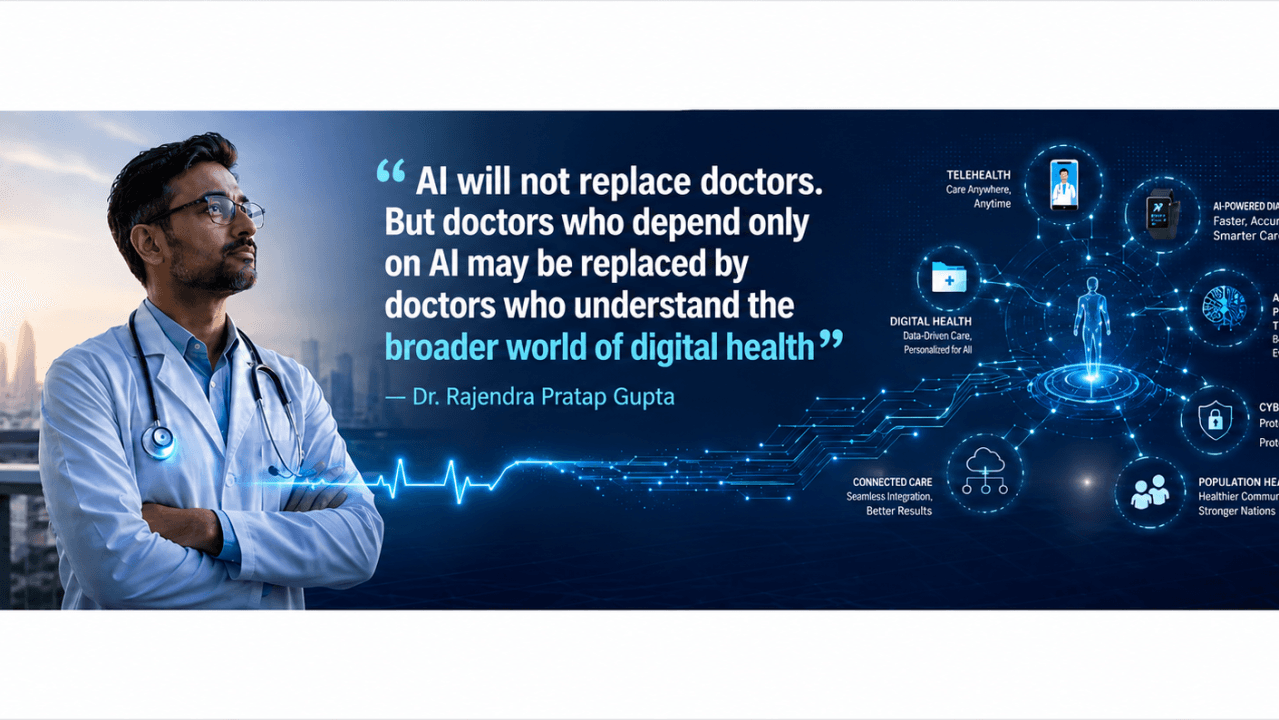
AI will not replace doctors. But doctors who depend only on AI may be replaced by doctors who understand the broader world of digital health - Dr. Rajendra Pratap Gupta
That distinction is everything. AI is one tool. Digital health is the operating system of real medicine. It includes data governance, AI, telemedicine, remote monitoring, digital therapeutics, interoperability, cybersecurity, clinical informatics, ethics, regulation, workflow redesign, patient engagement and the wisdom to know when not to trust the algorithm. A doctor who uses AI without understanding digital health is like a pilot who trusts autopilot without knowing how to fly. It may work in clear weather. But when the storm comes, and in medicine, it always does - that ignorance becomes dangerous.
The future of medicine is not a contest between the physician and the machine. The future of medicine is technology woven into every consultation, every diagnosis, every hospital, every home and every patient journey. The physician who commands this technology will become more valuable, not less, because no machine can replace judgement, accountability, empathy and human trust.
The machine may read the scan. But the doctor must decide what that scan means for a mother, a child, a family, a life. That space between data and meaning is where medicine lives. But doctors can stand in that space only if they understand the technology well enough to question it, guide it, govern it and use it responsibly.
So here is my Doctors’ Day challenge - offered with respect, but without apology. Give yourself one year. Not a lifetime. One year. Twelve months to move from being a spectator of digital health to becoming a serious learner, practitioner and leader of it. Learn it the way you once learned anatomy - broadly, deeply and urgently. Do not just learn AI because it is fashionable. Learn digital health because your patients will need doctors who can navigate the new world of care. Stop living in the comfort of past accolades. Ask yourself honestly: am I preparing for the medicine of next year, or defending the medicine of the last decade?
Do not just learn AI. Master digital health. The definition of “doctor” is being rewritten. Make sure you are holding the pen.
Meet the Clinician of the Future at www.globalsummit.health
This will be an eye-opener for every doctor who wants to understand where medicine is heading and how to prepare for it. Join us to discover how you can become the clinician of the future -digitally fluent, technology-enabled, patient-centered, and ready for the next era of healthcare.
With you in your journey to help you master Digital Health. Look up www.digitalhealth.ac.in
Dr. Rajendra Pratap Gupta, PhD
Chairman
Academy of Digital Health Sciences
#digitaldoctor #digitalhealth #healthcare #innovation #ai #artificialintelligence #clinicianofthefuture #digitalhealth #academyofdigitalhealthsciences
Share this article
Pass it along to a colleague in healthcare or digital health.
Related articles
Keep exploring insights from GDHS.
Oct 04, 2026 · 7 min read
I Didn't See It Coming So Soon: The Sentence That Will End Many Healthcare Careers
Dr. Rajendra Pratap Gupta examines how rapidly advancing AI could reshape healthcare roles and why leaders need to move from discussion to implementation.
Oct 01, 2026 · 3 min read
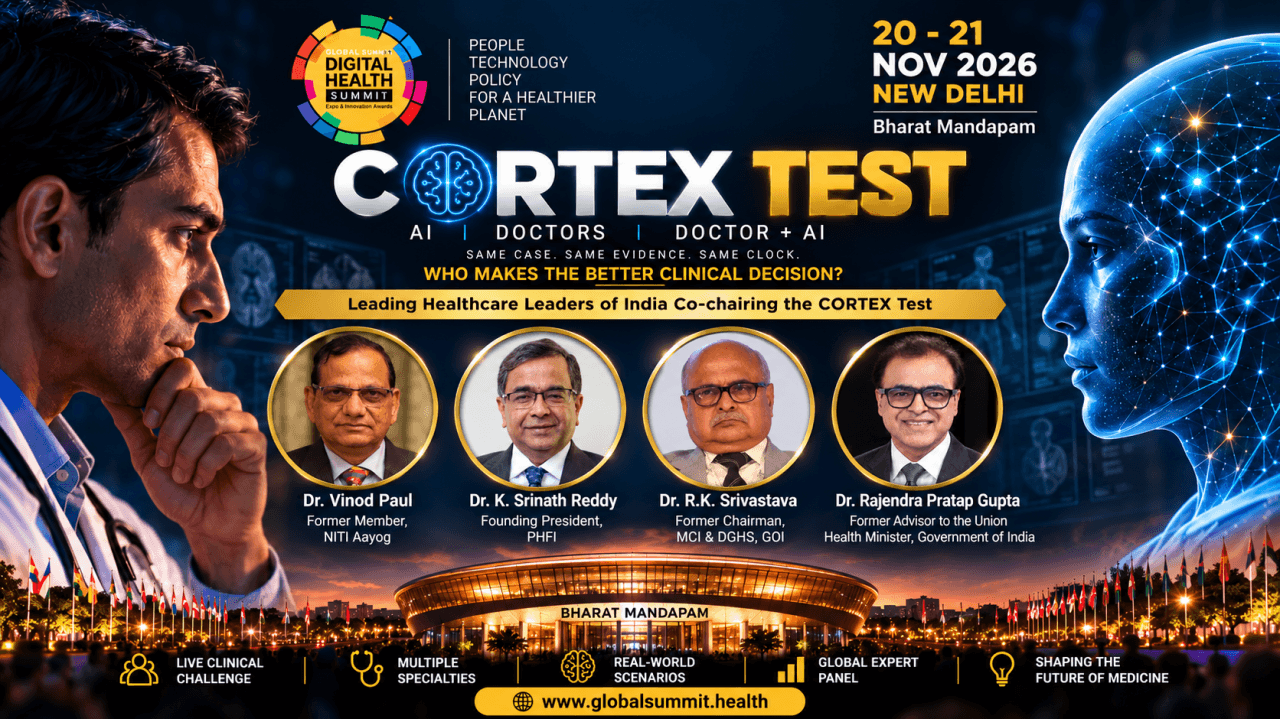
CORTEX TEST: The Day Medicine Puts AI on Trial
The CORTEX Test at GDHS 2026 compares AI, doctors and doctors using AI in a live clinical challenge across multiple specialties.
Sep 06, 2026 · 10 min read
Your Health AI May Be Brilliant. But Will the World Ever Find It?
Discover how the Global AI Hub and Technology Recommendation Council connect health AI innovators with customers, clinical experts and global partners.
Aug 30, 2026 · 8 min read
5X Registrations this year: This is the biggest summit focussed on ‘Implementing AI in Healthcare’
Why GDHS 2026 registrations are growing fivefold as healthcare leaders prepare to adopt AI through practical demonstrations and global expertise.