I Didn't See It Coming So Soon: The Sentence That Will End Many Healthcare Careers
Dr. Rajendra Pratap Gupta examines how rapidly advancing AI could reshape healthcare roles and why leaders need to move from discussion to implementation.
by Dr. Rajendra Pratap Gupta
October 04, 2026
7 min read
I recently spoke at Asia Pacific Medical Technology Association (APACMed) in Singapore, and I shared one parting message - ‘In the next three years, none of you will do what you do today’.

I believe that in the next twelve months, some of the most respected doctors, hospital CEOs and healthcare executives you know will say one sentence:
"I didn't see it coming so soon."
It will not be an excuse. It will be a confession. Read this till the end, and then decide which side of that sentence you want to be on.
The 18-Month Countdown Has Already Begun
My assessment is simple. The next four to six quarters will bring more change to how we diagnose, treat, monitor and follow up with patients than most of us have witnessed in our entire careers.
Not in ten years, not "someday," but in the next eighteen months.
And no one is exempt: not the doctor, the nurse, the pharmacist, the hospital administrator, the pharma executive, the MedTech leader or the CEO. The dominant model of healthcare delivery is changing, and it is changing faster than most leaders are prepared to admit.
The Stampede Is Coming — The Data Says You Are Already Behind
In 2023, only 38% of physicians surveyed by the American Medical Association used AI professionally. In 2026, that number is 81%. That is not a trend; it is a stampede.
The US FDA has now authorized more than 1,600 AI-enabled medical devices that read scans, detect diabetic retinopathy, assess cardiac risk and dose insulin, right now, while many leaders are still debating whether AI is "ready."
So ask yourself honestly: when your patient already uses AI, your junior doctor uses AI, and your competitor runs on AI, what exactly is your advantage?

Addressing APACMED Mainstage
A New Frontier Model Every 20 to 90 Days
Here is the fact that should keep every healthcare leader awake at night: new frontier AI models are now arriving every 20 to 90 days. Each one is more capable than the last at reasoning, reading, diagnosing and deciding.
Think about what that means. Your three-year strategic plan will be overtaken by a dozen technology leaps before it is complete. Your annual budget cycle is already too slow for the pace of change. And this is why even if you have the best-paid team in the industry, you are still among the most vulnerable. A brilliant team trained for yesterday's world is still trained for yesterday's world.
Talent without foresight is just expensive inertia.
Size Is No Shield: Ask Intel
Intel once dominated computing. It missed the AI shift and ended up planning to cut roughly 22% of its workforce. Meanwhile, Anthropic, founded only in 2021, reportedly reached about $4.6 billion in revenue in 2025, twelve times the year before. A company barely five years old is now moving faster than giants built over half a century.
Healthcare will have its own Anthropics. They will not look like today's hospitals or think like today's pharma companies. They will carry no legacy IT, no 30-year-old workflows and no bloated hierarchies. They will not need your permission, and they will not wait for you to catch up.

Photograph taken at APACMED Conference when I asked a question to the audience
At the APACMed Conference in Singapore on September 29, I asked a room full of industry leaders a simple question:
“How many of you are actually using AI or digital health meaningfully in your organizations today?”
Only about one-third of the room raised their hands. That moment, captured in the photograph, said more than any slide could.
We are talking endlessly about AI transforming healthcare, but a large part of the industry is still watching from the sidelines. The gap between awareness and implementation is now becoming dangerous. Because over the next four to six quarters, healthcare delivery will change faster than many organizations are prepared for.
The question is no longer whether AI and digital health will become important. The question is:
How much ground will you lose before you start implementing them?
That show of hands in Singapore should concern every healthcare leader. If only one-third of a highly informed industry audience is actively using these technologies today, the real issue is not access to innovation. It is readiness, leadership and speed of execution.
The winners will be those who see early, understand fast, learn what is becoming dominant and implement before everyone else does. Everyone else risks being forced to adapt after the market has already moved.
The Uncomfortable Truth About Seniority
Looking at today’s situation, more than half of the healthcare workforce would be ready to be replaced because of being digitally handicapped.
Let me say what many think but few say publicly: perhaps half of today's middle and senior healthcare leaders could become irrelevant to their current roles. Not because they lack intelligence, and not because their experience is worthless, but because experience becomes a trap when it teaches you to perfect a system that is being replaced.
A 30-year career is a tremendous asset, unless it becomes 30 reasons to resist the next four quarters. The leaders who survive will not be the most senior. They will be the ones who see first, understand fast and implement before everyone else.
Even If You Start Today, You Are Catching Up
Let me be blunt. If you begin planning today, you are not getting ahead. You are merely catching up. The race started without you, and the only question left is how fast you can close the gap.
My job is to speed up that transition for you. That is why I am bringing to India the people who are actually building and implementing this future, the ones who can guide you rightly on what to adopt, what to ignore and what to do next. You do not need more opinions. You need direction from people who are already there leading this race in healthcare transformation.
Two Days That Could Decide Your Future
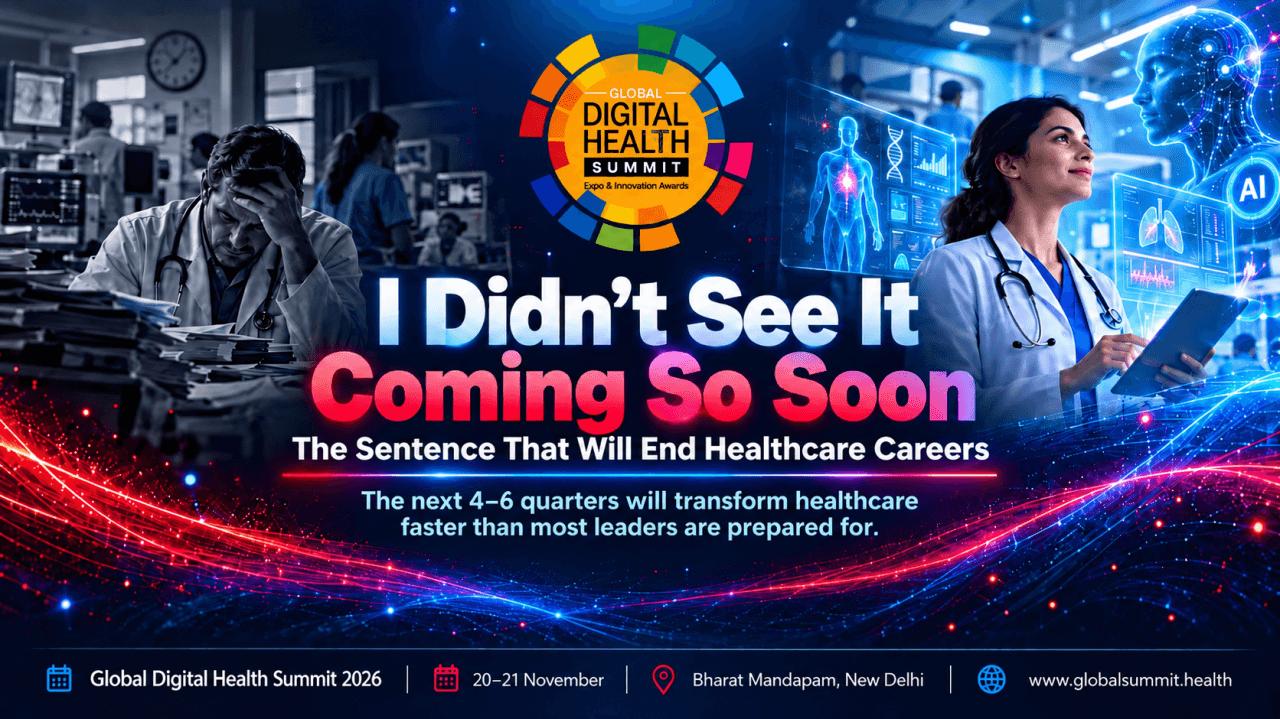
This is exactly why we built the Global Digital Health Summit 2026, on 20–21 November at Bharat Mandapam, New Delhi. This is not another conference debating whether AI will enter healthcare; that debate is over. GDHS brings together clinicians, hospital leaders, innovators, policymakers and the builders of this future, not predicting it, but doing it.
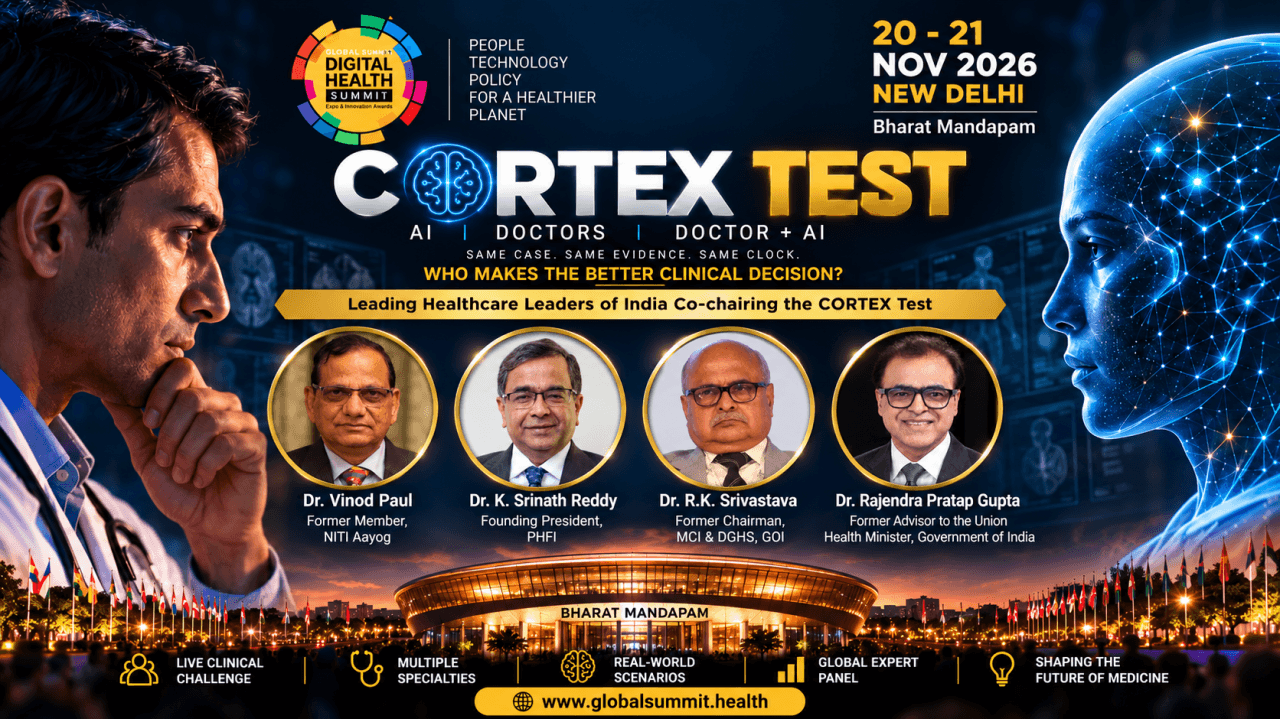
You will see the Hospital of the Future, the Clinician of the Future and Pharma of the Future. And you will witness the CORTEX Test, a live clinical challenge in which AI, doctors, and doctors empowered by AI face real clinical situations.
The question is no longer "Will AI learn medicine?" It is: "Has AI learned to practise medicine, and where does that leave you?"
The Choice Is Yours, But the Clock Is Not
You can invest two days now, or you can spend the next two years explaining why you "didn't see it coming so soon." We are doing our best to show you the future, and remember, closing your eyes to reality does not take the reality away. It is knocking your door.
We will see you at www.globalsummit.health alongside global leaders already shaping what comes next.
The window to prepare is narrowing.
Come now to challenge your assumptions, reset your strategy, and define your action plan to implement over the next few months.
Do not wait until the change becomes obvious, as by then, the leaders will already have moved.
Dr. Rajendra Pratap Gupta, PhD
#GlobalDigitalHealthSummit #GDHS2026 #ArtificialIntelligence #HealthcareAI #DigitalHealth #FutureOfHealthcare #HealthcareLeadership #HealthInnovation #AIinHealthcare #HospitalOfTheFuture #ClinicianOfTheFuture #PharmaOfTheFuture #HealthcareTransformation #FutureReady #Leadership #CORTEXTest #HealthTech #DigitalTransformation #BharatMandapam #NewDelhi Global Digital Health Summit, Expo & Innovation Awards Health Parliament #singapore #APACMED #Medicaldevices
Share this article
Pass it along to a colleague in healthcare or digital health.
Related articles
Keep exploring insights from GDHS.
Oct 01, 2026 · 3 min read
CORTEX TEST: The Day Medicine Puts AI on Trial
The CORTEX Test at GDHS 2026 compares AI, doctors and doctors using AI in a live clinical challenge across multiple specialties.
Sep 06, 2026 · 10 min read
Your Health AI May Be Brilliant. But Will the World Ever Find It?
Discover how the Global AI Hub and Technology Recommendation Council connect health AI innovators with customers, clinical experts and global partners.
Aug 30, 2026 · 8 min read
5X Registrations this year: This is the biggest summit focussed on ‘Implementing AI in Healthcare’
Why GDHS 2026 registrations are growing fivefold as healthcare leaders prepare to adopt AI through practical demonstrations and global expertise.
Aug 25, 2026 · 6 min read
List of Recommended Health AI Technologies for 2026-2027. If Your Technology Deserves Adoption, Put It to the Test
How the GDHS 2026 Technology Recommendation Council evaluates health AI technologies for adoption, credibility and real-world implementation.