Your Health AI May Be Brilliant. But Will the World Ever Find It?
Discover how the Global AI Hub and Technology Recommendation Council connect health AI innovators with customers, clinical experts and global partners.
by Dr. Rajendra Pratap Gupta
September 06, 2026
10 min read
Global Digital Health Summit 2026 | 20–21 November | Bharat Mandapam, New Delhi
There is a hard truth every health-tech founder eventually discovers: building a great product is not enough. You can have exceptional technology, strong clinical evidence, a compelling pilot and a passionate team, and still struggle to reach the hospitals, governments, insurers, investors and global partners who can take that innovation to scale. In healthcare, the biggest bottleneck is often not invention. It is discovery, trust and access.
The opportunity in front of founders is enormous. The global AI-in-healthcare market is expanding rapidly, with estimates projecting growth from about $36.67 billion in 2026 to nearly $194.79 billion by 2031, at a CAGR of close to 40%. At the same time, digital health funding is becoming more concentrated. In 2025, US digital health companies raised around $14.2 billion, but fewer deals were completed even as average deal sizes increased. AI-enabled companies captured a growing share of that capital. The message is becoming clear: healthcare AI is attracting serious money, but visibility, credibility and access are increasingly deciding who gets funded, adopted and scaled.
The Next Global Health-Tech Company May Already Exist & It May Simply Be Invisible
Somewhere today, a founder may have already built an AI solution that can detect disease earlier, improve hospital efficiency, reduce clinical workload, improve medication safety or extend specialist care to underserved communities. That company may have developed something with the potential to transform healthcare, but if the right decision-makers never encounter it, the innovation may remain stuck in pilots, presentations and small deployments.
This is the challenge the Global Digital Health Summit 2026 wants to address differently. Instead of asking founders to spend months travelling from hospital to hospital, investor to investor and country to country, the idea is to bring a concentrated ecosystem of decision-makers together and create an environment where meaningful discovery can happen in two days.
What If Two Days Could Save You Two Years of Market Access?
For most founders, entering a new healthcare market is painfully slow. You identify the right hospital, find the right decision-maker, secure an introduction, conduct a demonstration, navigate clinical validation, understand procurement, address interoperability, respond to regulatory questions and then wait. Multiply that process across several countries and the journey can take years.
Now imagine bringing hospital CEOs, health-system leaders, clinicians, policymakers, regulators, pharma executives, MedTech companies, technology leaders, investors and international healthcare stakeholders into one venue. Imagine giving selected founders the opportunity to demonstrate their technology directly to people who influence adoption, partnerships, procurement and policy.
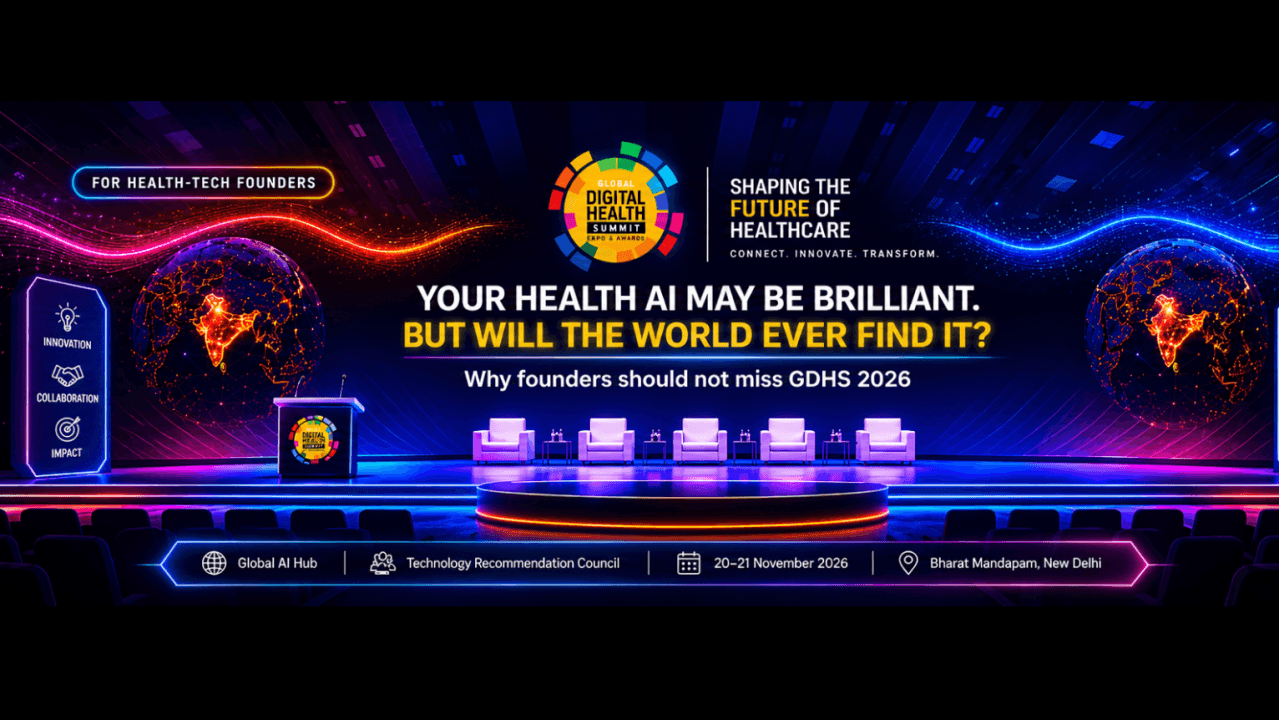
That is the ambition behind the Global AI Hub at GDHS 2026.
Don’t Just Buy a Stall. Enter a Global Healthcare Marketplace
Traditional exhibitions are built around footfall. Companies rent booths, display banners, hand out brochures and hope that someone important happens to stop. Health AI deserves a more intelligent model.
The Global AI Hub is designed as a curated discovery platform where innovative companies can demonstrate working technologies in an environment built around serious healthcare conversations. The objective is not simply to create visibility, but to enable founders to meet the people who can challenge their technology, validate its relevance, become customers, open new markets, enter into partnerships or help create pathways toward scale.
For a founder, the important question is therefore not, “How many visitors will come to my booth?” It is:
“How many months of customer discovery and relationship-building could I compress into these two days?”
Your Biggest Competitor May Not Be Better Technology. It May Be Better Access
Healthcare markets do not always reward the best innovation first. They often reward the innovation that becomes visible to the right people, earns trust faster and develops stronger institutional relationships. That is why founders frequently see technically weaker competitors grow faster simply because they have better market access, stronger networks or greater credibility.
This is especially difficult for outstanding innovators from India, Asia, Africa, Latin America and emerging health-tech ecosystems, where companies may be solving some of healthcare’s most important problems without having access to the global networks available to larger companies.
GDHS wants to help change that equation.
Getting Seen Is Only Half the Battle. Getting Believed Is the Other Half
Every hospital leader has experienced a compelling health-tech demo. Every company claims its technology improves outcomes, reduces costs or transforms patient care. The problem is that healthcare cannot operate on claims alone. A good presentation is not evidence. A successful pilot does not automatically mean a solution can scale. An award does not necessarily tell a hospital whether the technology is clinically valuable, interoperable or deployable in the real world.
This is precisely why the Technology Recommendation Council is potentially one of the most important innovations globally being introduced at GDHS 2026.
From “Award Winning” to “A Recommended Technology”
The Technology Recommendation Council is being created to address one of the biggest gaps in the digital-health ecosystem: structured, independent evaluation that can help decision-makers distinguish promising innovation from technology that may have genuine potential for wider deployment.
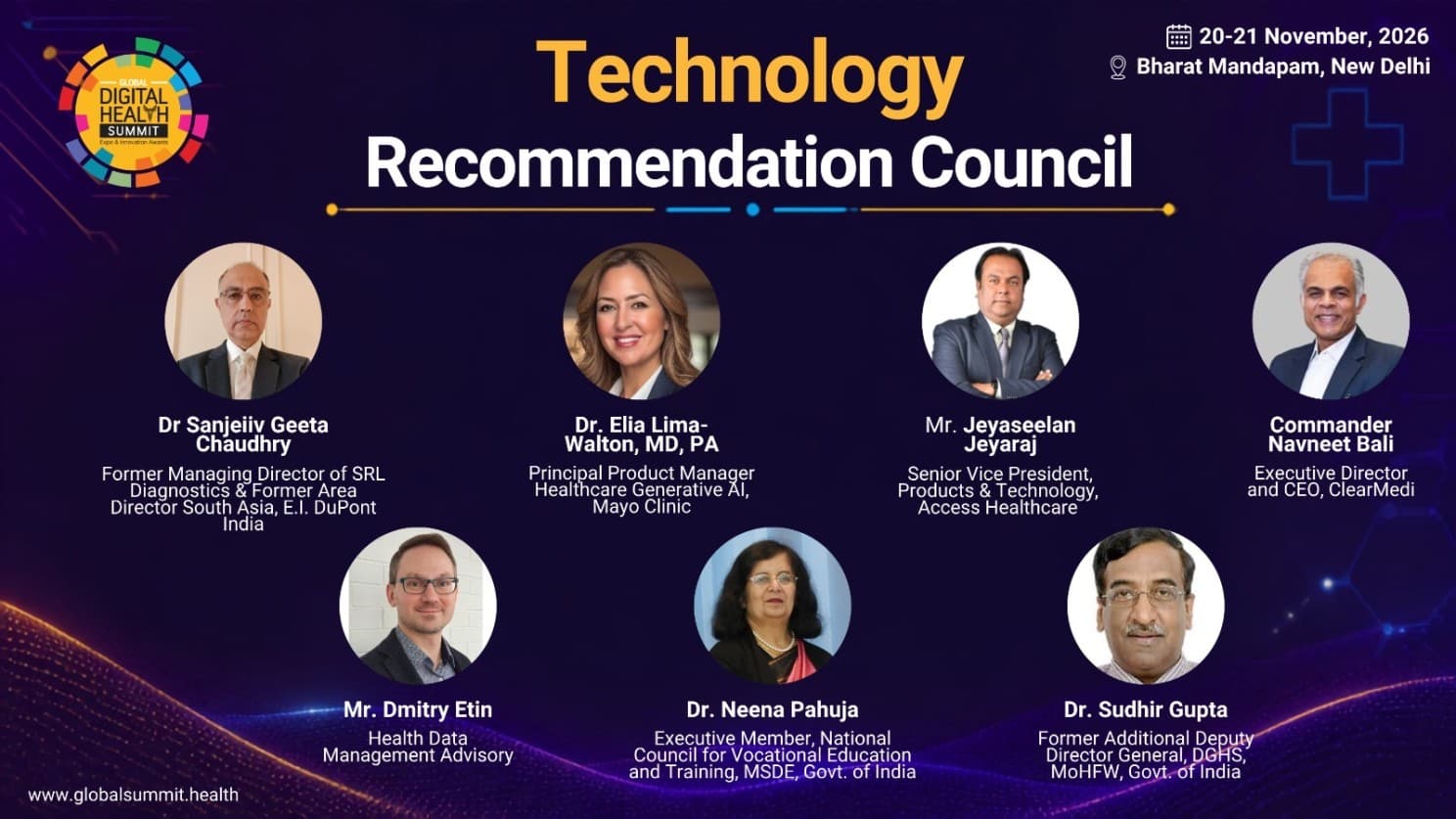
The intention is to bring together expertise from healthcare, technology, academia, industry, policy and other relevant domains to examine selected technologies from multiple perspectives. For founders, this can provide something far more valuable than another trophy: the possibility of credible external scrutiny and a recommendation that can become part of future conversations with hospitals, health systems and partners.
Awards celebrate you. Recommendations can open doors. The team at GDHS under my leadership will create a catalogue of recommended technologies and share it with your details ( if your solution is ‘Recommended after evaluation’ to the potential clients including central and state governments, hospitals and other HCPs’.
The Global AI Hub Gets You Seen. The Technology Recommendation Council Helps You Get Taken Seriously.
This is where the GDHS model becomes particularly powerful for founders. The Global AI Hub is about discovery. The Technology Recommendation Council is about structured credibility. The broader GDHS ecosystem is about relationships, partnerships and pathways toward adoption. Put together, these elements create something more valuable than a conference exhibition. They create the beginnings of a market-access accelerator for health innovation.
No summit can guarantee a customer, investment or procurement decision. But a summit can dramatically increase the probability of the right founder meeting the right decision-maker at the right moment.
And in healthcare, one meeting can change the trajectory of a company.
One Hospital CEO Could Change Your Year
A conversation with a hospital CEO could lead to a pilot. A discussion with a clinician could reveal the missing feature preventing adoption. A regulator could help you understand what needs to change before entering a new market. A health-system leader could open access to an entirely new geography. A technology company could become a distribution or implementation partner. An investor could finally see the scale of the problem you are solving.
The value of a summit is therefore not the number of people you meet. It is the quality of the people who discover what you have built.
50+ Countries of Relationships Cannot Be Built in Two Days. But They Can Begin There.
Over the years, the Global Digital Health Summit has built relationships / representation from across more than 50 countries and brought together policymakers, regulators, clinicians, hospital leaders, technology companies, pharma, MedTech and international healthcare stakeholders.
For founders, that creates a rare concentration of potential relationships.Twenty and twenty-one November should therefore not be viewed merely as two conference dates. They should be viewed as 48 hours of concentrated healthcare opportunity.
For a founder who would otherwise spend months identifying potential customers, approaching health systems, travelling to different markets and repeatedly establishing credibility, the opportunity to engage with a diverse global healthcare ecosystem in one place can be extraordinarily valuable.
Healthcare Does Not Need Another 10,000 Pilots
The healthcare industry already has thousands of pilots. Many never scale. Some of the most promising technologies remain permanently trapped between proof of concept and procurement.
Healthcare now needs better mechanisms for discovery, validation and adoption.
It needs hospitals to discover technologies they did not know existed. It needs clinicians to interact with founders early enough to shape products that actually fit clinical workflows. It needs regulators and policymakers to understand what innovation is emerging. It needs founders to receive meaningful feedback from real-world decision-makers. And it needs promising companies to escape what has become known as pilot purgatory.
A brilliant algorithm sitting permanently in a pilot is not innovation. It is a rehearsal. Innovation begins when technology survives contact with a real health system.
That is why the theme of GDHS 2026 is Artificial Intelligence in Action. The conversation has moved beyond what AI could theoretically do. The question now is what AI can actually deliver.
Stop Pitching Only to Investors. Start Meeting the People Who Can Actually Use Your Technology- Presence on the biggest platform matters a lot!
Startups often focus overwhelmingly on fundraising. But the strongest validation for a health-tech company is not another pitch deck. It is adoption. A hospital deploying your technology is validation. A clinician relying on it is validation. A health system expanding it is validation. A government exploring it is validation. A global partner taking it into another market is validation. The founders who build lasting healthcare companies will therefore need more than capital.
They will need customers, credibility, clinical champions, policy understanding and global relationships.
GDHS 2026 is being designed around precisely that ecosystem.
Somewhere, the Next Global Healthcare Company Is Waiting to Be Discovered. It may not come from Silicon Valley. It may be being built today in Bengaluru, Hyderabad, Delhi, Nairobi, Singapore, São Paulo, Dubai, London or a city the global healthcare industry has barely noticed. Its founder may not have a global network.Its marketing budget may be small. Its technology may nevertheless be extraordinary. The quality of an innovation should determine how far it travels, and not the size of the founder’s contact list.
That is the opportunity we have created for you at the Global AI Hub and Technology Recommendation Council at the Global Digital Health Summit 2026.
You Spent Years Building It. Give the World Two Days to Discover It.
If your technology can genuinely improve healthcare, then the people who run hospitals, shape health systems, invest in innovation and influence adoption should know that it exists.
20–21 November 2026. Bharat Mandapam, New Delhi.
Two days.
Global healthcare leaders.
Potential customers.
Clinical experts.
Policy leaders.
Technology partners.
And an opportunity to move from being built to being discovered, from being discovered to being believed, and from being believed to being adopted.
If you have built something healthcare should not miss, perhaps GDHS 2026 is where the world should discover it.
Visit www.globalsummit.health
Let us help you scale faster!
Dr. Rajendra Pratap Gupta, PhD
#GDHS2026 #GlobalDigitalHealthSummit #HealthAI #DigitalHealth #HealthTech #AIinHealthcare #HealthTechStartups #StartupFounders #HealthcareInnovation #GlobalAIHub #TechnologyRecommendationCouncil #FutureOfHealthcare #ScalingInnovation #MarketAccess #ArtificialIntelligenceInAction
Share this article
Pass it along to a colleague in healthcare or digital health.
Related articles
Keep exploring insights from GDHS.
Oct 04, 2026 · 7 min read
I Didn't See It Coming So Soon: The Sentence That Will End Many Healthcare Careers
Dr. Rajendra Pratap Gupta examines how rapidly advancing AI could reshape healthcare roles and why leaders need to move from discussion to implementation.
Oct 01, 2026 · 3 min read
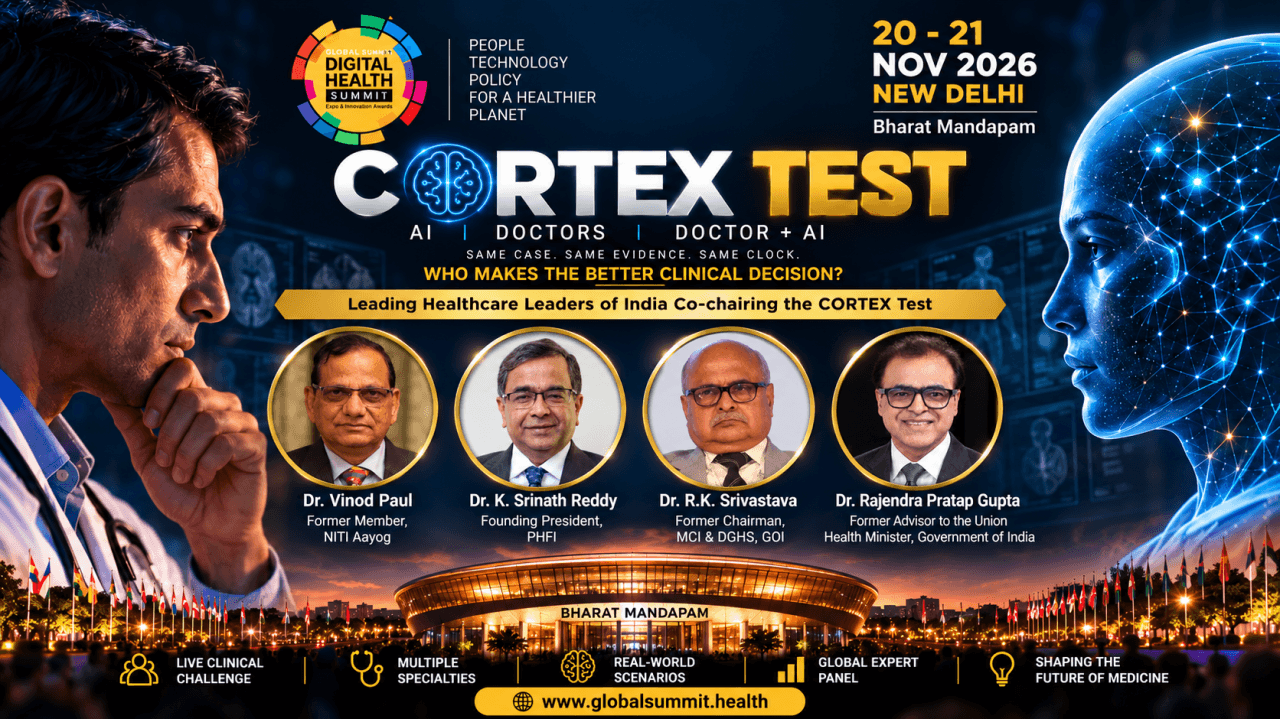
CORTEX TEST: The Day Medicine Puts AI on Trial
The CORTEX Test at GDHS 2026 compares AI, doctors and doctors using AI in a live clinical challenge across multiple specialties.
Aug 30, 2026 · 8 min read
5X Registrations this year: This is the biggest summit focussed on ‘Implementing AI in Healthcare’
Why GDHS 2026 registrations are growing fivefold as healthcare leaders prepare to adopt AI through practical demonstrations and global expertise.
Aug 25, 2026 · 6 min read
List of Recommended Health AI Technologies for 2026-2027. If Your Technology Deserves Adoption, Put It to the Test
How the GDHS 2026 Technology Recommendation Council evaluates health AI technologies for adoption, credibility and real-world implementation.