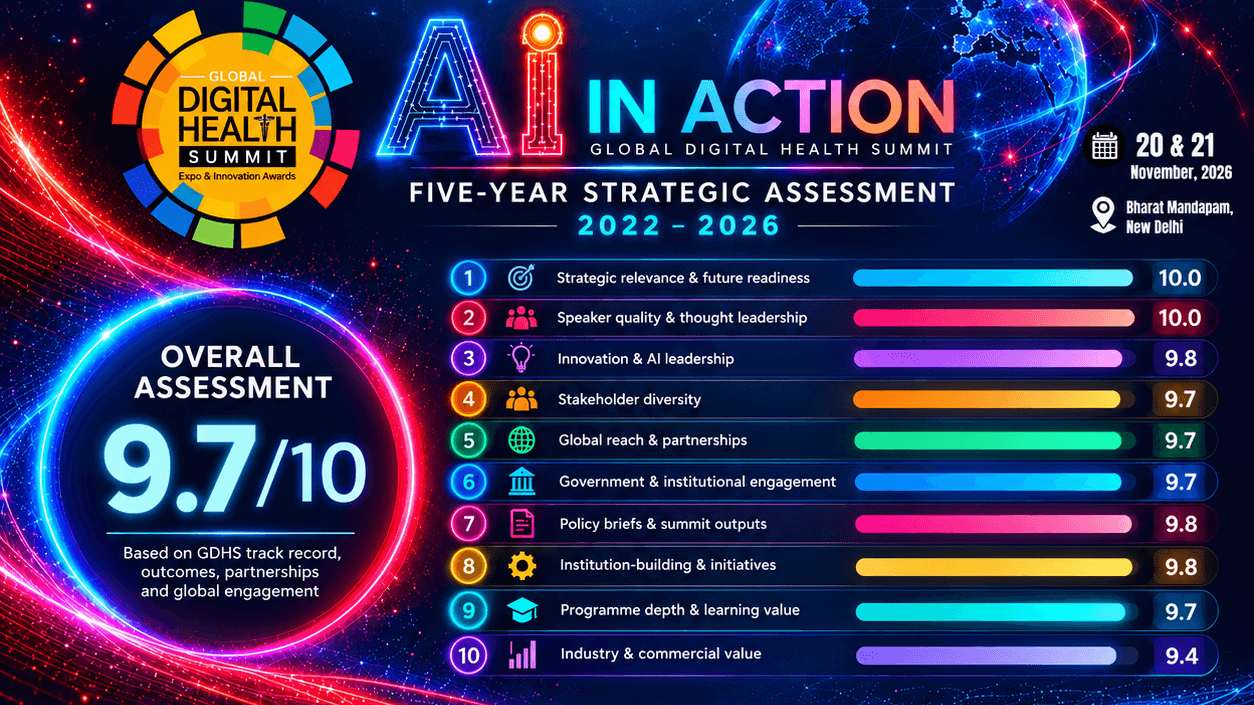
Why GDHS Scores 9.7/10? The Global Leaders Who Vouch for GDHS
An AI-based assessment scored GDHS 9.7/10 — and the stronger evidence is the ministers, regulators, UN and industry leaders who return year after year.
Dr. Rajendra Pratap Gupta
October 17, 20269 min read
What makes a global summit truly exceptional given that dozens of summits happen every year? Is it the number of delegates, the stature of its speakers, the policies it influences, or the transformations it inspires? I believe the summit succeeds when it triggers a new thought process, grounds-up change and a global shift — at GDHS, we do it all.
Since the world is now using AI extensively to do routine stuff, we ran an AI-based assessment of the Global Digital Health Summit (GDHS) across multiple dimensions, and it awarded www.globalsummit.health an overall score of 9.7 out of 10. But numbers alone cannot tell the full story. The most compelling evidence comes from the people who have experienced the summit themselves. Our philosophy, principles and approach have made GDHS the biggest healthcare summit since 2024, and in Digital Health, amongst the most impactful healthcare summits in the globe. It is all because of leaders like you and we owe you a debt of gratitude.
Since 2022, GDHS has collected hundreds of video testimonials from ministers, regulators, United Nations and OECD officials, healthcare pioneers, academic leaders and industry executives. The summit also reports that 97.6% of attendees rate their experience Outstanding.
Their participation, continued engagement and recorded testimonials offer a perspective on what GDHS has achieved. But before we even acknowledge the success, we must thank our esteemed sponsors and exhibitors, who have generously supported without interfering with our agenda, and most importantly, the delegates like you — you rarely asked for a discount and respected the value they derive from this summit.
As a global summit with a mission, we first decide the agenda based on the needs of the healthcare sector, and then do our outreach to the supporters. We never broadcast it live or take more than 2,000 delegates, to ensure the quality of the interaction and a great experience for those coming from across the world to attend.
Speaker quality: 10 out of 10
GDHS is amongst the very few summits across the world where sponsorships are delinked from speaking opportunities. Even those who spend USD 200K cannot have a guaranteed speaking opportunity, unless the agenda and their outstanding contribution enables them to go on stage and share their path-breaking work.
Dr. Devi Shetty, Founder and Chairman of Narayana One Health, has participated in GDHS in 2022, 2023 and 2024. His continuing association brings the perspective of a healthcare pioneer who has demonstrated how innovation and scale can make quality care more accessible.
Youngsuk “YS” Chi, Global Chairman of Elsevier, brings the global perspective of one of the world’s leading scientific-information organizations. He shared last year the future of medical knowledge, research, education and evidence-based healthcare — and what it takes to be a leader in this age.
Dr. Ram Charan, considered the most valuable management consultant alive by Forbes, brought an equally important dimension: technology transformation is ultimately a leadership challenge. Healthcare institutions need leaders capable of converting technological possibilities into organizational change. This year, we are bringing a great global institution builder, Rajat Gupta, who built the Indian School of Business and the Public Health Foundation of India (PHFI) besides many others. I believe we will have to create institutions and leaders who can outlast this AI churn, and Rajat is the best personality to tell us how to do it.
Dr. Joseph C. Kvedar, Professor at Harvard Medical School and GDHS Co-Chair, contributed decades of experience in connected healthcare and digital medicine. He coined the term “Connected Health”. We will advance the connected health agenda this year in the best way possible.
The participation of Marc Jones, Trustee, Stanford University, Chairman of Health, was a great lesson for those who attended his keynote. He gave the formula for leadership, and what brings the best in you.
Government engagement: 9.7
Healthcare transformation cannot succeed without governments, regulators and policymakers working alongside innovators. Perhaps one of the most memorable endorsements comes from Dr. Rajeev Raghuvanshi, Drugs Controller General of India, who has attended every edition since 2022.
In his written testimonial, he describes GDHS as:
“The one healthcare summit I never miss.”
That statement carries particular significance coming from the country’s chief drug regulator. It reflects a sustained personal commitment to the summit across multiple years.
Shri Piyush Goyal, Union Minister of Commerce and Industry, participated in 2023, bringing national economic and industrial leadership into the healthcare transformation conversation. Dr. Sunil Kumar Barnwal, CEO of the National Health Authority (NHA), represents the institution driving important elements of India’s digital-health infrastructure. Shri Abhishek Singh, CEO of the IndiaAI Mission, brought the perspective of national AI policy and implementation.
Vaidya Rajesh Kotecha, Secretary, Ministry of Ayush; Shri Bharat Lal, Secretary General of the National Human Rights Commission; and Dr. Sanjay Sood added perspectives spanning traditional medicine, human rights and population-scale telemedicine.
This is where GDHS differentiates itself: bringing policymakers, industry, implementers and care-seekers into the same conversation.
Global reach: 9.7
GDHS may be hosted in India, but its influence and participation extend far beyond national boundaries.
Dino Cataldo Dell’Accio, Chief Information Officer of the United Nations Joint Staff Pension Fund, spent two days at the summit and brought global exposure in international institutional technology and digital governance. Dr. Steve MacFeely, Chief Statistician and Director of Statistics and Data at the OECD, brought the perspective of evidence, measurement and trustworthy data. Dr. José Luis Cobos Serrano, President of the ICN – International Council of Nurses, represents a profession encompassing approximately 30 million nurses worldwide.
Ann Mond Johnson, CEO of the ATA, left a lasting message: “We need to work through patients and not just with patients.” Professor Dean Ho, Director of the Institute for Digital Medicine at the National University of Singapore, represents the frontier of research-led digital medicine.
Other international leaders include Prof. Rifat Latifi, Health Minister of Kosovo and creator of the Virtual Hospital; Prof. Dipak Kalra; and Dr. Tobias Silberzahn, who will lead the Outlook 2027 meet at GDHS this year.
No summit in India has hosted the founder of the Internet — we did it last year, when Dr. Vint Cerf delivered the keynote at GDHS 2025. Dr. Alain Labrique, Director at the World Health Organization, has spoken twice at GDHS. The summit has also hosted Nobel Peace Laureate Muhammad Yunus, and senior representatives of the UN and WHO.
Innovation and AI leadership: 9.8
The defining question for healthcare is no longer whether AI will transform medicine. It is how rapidly, responsibly and effectively healthcare systems can implement it.
Bakul Patel, Google’s Senior Director for Global Digital Health Strategy and Regulatory and GDHS Chair Emeritus, brings a rare combination of technological and regulatory experience. Maneesh Goyal, Chief Operating Officer of Mayo Clinic Platform, brings the perspective of building scalable platforms for healthcare innovation. Dr. Elia Lima-Walton, former healthcare generative-AI product leader at Mayo Clinic, contributes practical experience translating emerging AI capabilities into clinical applications.
Dr. Ali Parsa, Founder of Babylon Health and Quadrivia AI, represents entrepreneurial efforts to redesign healthcare delivery through AI. Dr. Ashish Atreja, Founder of VALID.AI and NODE.Health, brought attention to a critical issue: AI technologies must be evaluated and validated before being trusted in healthcare. Professor Shafi Ahmed and Dr. Karen Pierce add clinical, surgical and research perspectives.
GDHS has also introduced initiatives including the Functional AI Pyramid, the Edison–Watson Digital Health Ecosystem, the Hippocratic Oath for the Digital Age, the Global Commission for 21st Century Healthcare (GC21CH) and the Consortium of Innovative Healthcare Universities.
The 2026 summit advances this agenda through its theme, AI in Action, including a planned live session comparing senior doctors and AI in clinical decision-making. We will train each one of you with a Level-2 certification in AI at this summit.
Industry and commercial value: 9.4
A global summit demonstrates value beyond discussions, through partnerships, adoption, innovation and commercial opportunities.
Sanjiv Navangul, MD and CEO of Bharat Serums And Vaccines Limited; Siddharth Shah, Vice Chairman of API Holdings; Tetsuya Yamada, Managing Director of OMRON Healthcare India; Sudarshan Jain, Secretary-General of the Indian Pharmaceutical Alliance; Meghan Huffman, VP of Digital Health at Novant Health; and Vikalp Sahni, Founder and CEO of Eka.Care, represent sustained industry engagement across editions.
GDHS 2026 aims to strengthen tangible outcomes through initiatives including the Global AI Hub and the CEOs’ Council for Hospitals of the Future — with many more surprises in store.
Stakeholder diversity: 9.7
Digital transformation will fail if it remains confined to boardrooms, technology companies and government departments.
Dr. T. Dileep Kumar, President of the Indian Nursing Council; Dr. R. Kim, Chief Medical Officer of Aravind Eye Hospital; and Col. (Dr.) Mohan Kubendra, National President of the Academy of Family Physicians of India, bring nursing, clinical practice and primary care into the conversation. Academic leaders including Prof. Sanjeev Prashar and Prof. Anil Kaul contribute insights into leadership development and institutional preparedness. Even the participation of former Indian cricket captain Ajinkya Rahane demonstrates that conversations about health and technology can resonate beyond the traditional healthcare community.
The verdict, in their voices
An AI system can assess a summit against defined criteria. But it cannot replace the judgment of leaders who participate, return and publicly associate themselves with its mission. The hundreds of recorded testimonials are therefore an important part of the GDHS story.
The 9.7 assessment is not a substitute for independent evaluation, nor does the stature of speakers alone establish impact. But the breadth of participation, repeat engagement and willingness of leaders to share their experiences provide meaningful evidence of the summit’s standing.
The next chapter is GDHS 2026: AI in Action, 20–21 November, Bharat Mandapam, New Delhi. This will be the most exciting edition of the summit ever.
The invitation is simple: come, experience the conversations, examine the outcomes and make your own assessment. This year will change your perspective on what the future looks like, and how you can prepare for it.
Watch the testimonials at www.globalsummit.health/testimonials.
Join the movement, and be the leader driving the future of healthcare.
We will see you at the summit.
Share this article
Pass it along to a colleague in healthcare or digital health.
Related articles
Keep exploring insights from GDHS.
Nov 01, 2026 · 5 min read
Discussion to a Decision - A Keynote at GDHS Could Trigger an Emergency Board Meeting
Insights that would force the industry to rewrite its strategy — why GDHS 2026 keynotes are designed to challenge hospital, pharma, MedTech and investor agendas.
Oct 20, 2026 · 5 min read
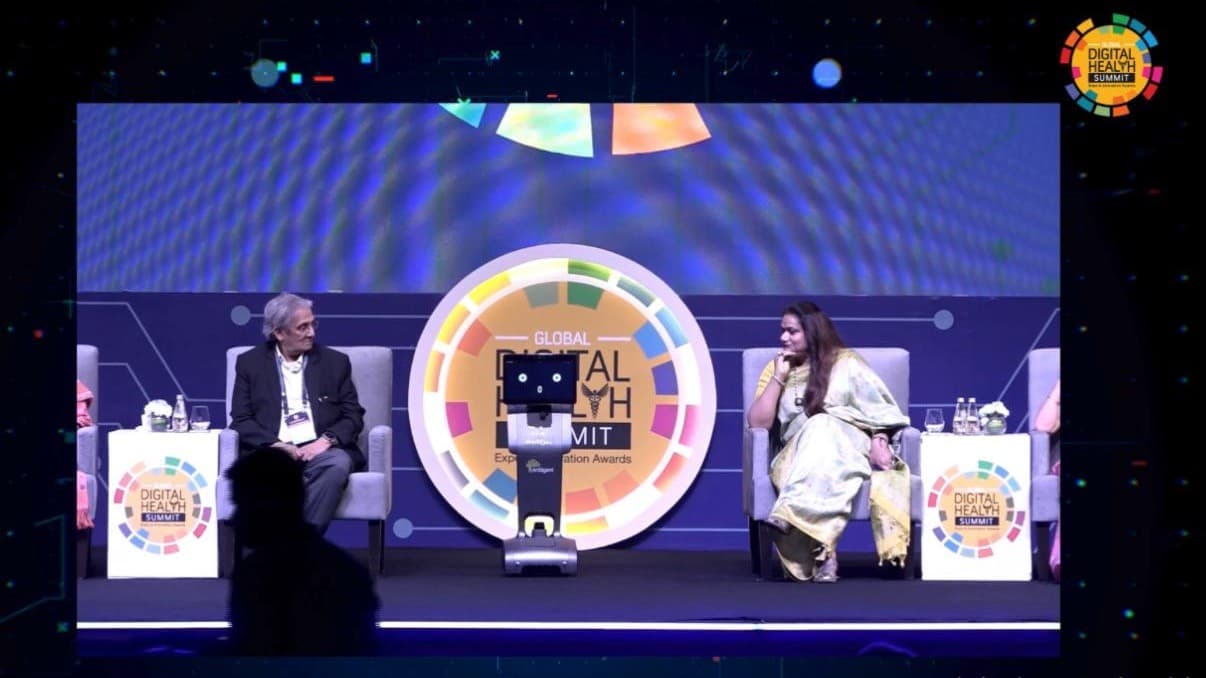
Where the Future Arrives First: Why GDHS Attracts the World's Most Unconventional Healthcare Leaders
From a robot panelist to Hospital of the Future and a 9.7/10 track record — why GDHS draws leaders who challenge the status quo, and why 2026 is its boldest edition yet.
Oct 09, 2026 · 4 min read
Are We Prepared for the Mental Health Emergency of the Digital Age? How can Start-ups help?
Why every healthcare CEO, pharmaceutical leader, policymaker, investor and technology innovator must rethink mental health before the digital revolution rewrites the human mind.
Oct 04, 2026 · 7 min read
I Didn't See It Coming So Soon: The Sentence That Will End Many Healthcare Careers
Dr. Rajendra Pratap Gupta examines how rapidly advancing AI could reshape healthcare roles and why leaders need to move from discussion to implementation.